
History of the Carriage Roads


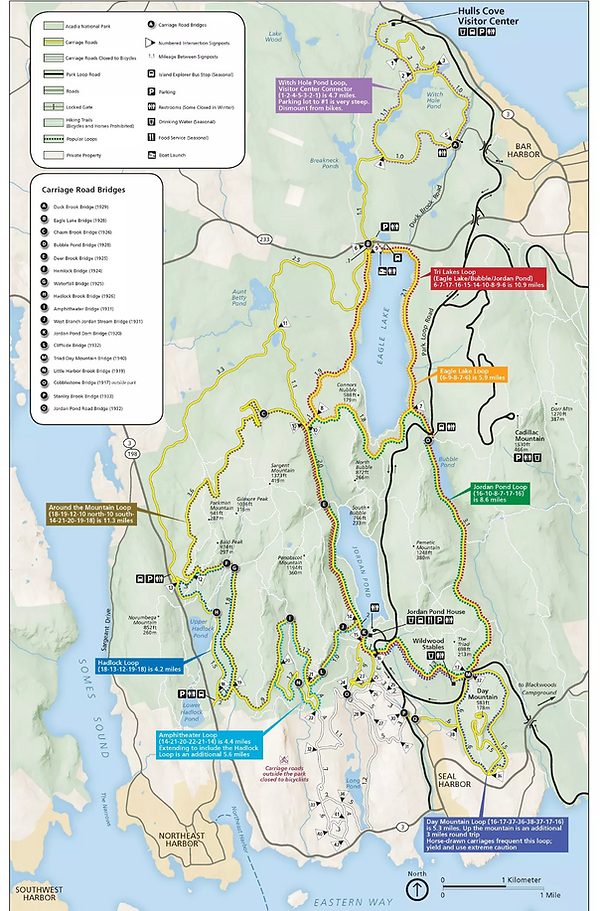
The carriage roads in Acadia were built between 1913 and 1940 by John D. Rockefeller Jr., who loved horses and carriage driving and wanted a quiet way to explore Mount Desert Island without automobiles. As cars started appearing on the island’s rough roads in the early 1900s, he worried they would spoil the peace for people on horseback and on foot, so he designed a completely car-free network just for them.
Rockefeller personally helped plan about 45 miles of crushed-stone carriage roads, designed with gentle grades and sweeping curves so horses and carriages could travel comfortably. The roads were carefully laid to follow the natural contours of the land and highlight views of mountains, ponds, forests, and the ocean. Along them, workers built 16 beautiful granite bridges and sturdy gatehouses, using local stone so everything blended with the landscape. The low granite boundary stones along the edges—sometimes called “Rockefeller’s teeth”—help protect both visitors and the terrain.
Over time, Rockefeller and his family donated the roads and much of the surrounding land to what became Acadia National Park. Today, the carriage roads are on the National Register of Historic Places and are still car-free, used for walking, biking, horseback riding, and cross-country skiing, carrying on his original vision of a quiet, horse-friendly way to experience the park.
History of Bar Harbor
Indigenous Roots
Long before Bar Harbor had a name, the area was home to the Wabanaki people, who lived seasonally along the coast and islands, harvesting fish and shellfish and traveling the waters of Frenchman Bay. Their deep knowledge of the land and sea shaped the region for thousands of years.
Early Settlement & the Name “Eden”
European settlers arrived in the late 1700s, drawn by fishing, shipbuilding, and farming. The town was originally called Eden, after Sir Richard Eden, an English statesman. Life here was rugged and maritime, centered on the working harbor and the surrounding forests.
Artists Discover the “Rusticators” (Mid-1800s)
In the 1840s and 1850s, landscape painters from the Hudson River School began visiting Mount Desert Island, captivated by its dramatic cliffs, clear light, and mountain-meets-sea scenery. Their paintings brought national attention, attracting early summer visitors—known as “rusticators”—who sought nature, simplicity, and fresh air.
The Gilded Age & the Golden Era of Bar Harbor
By the late 1800s, Bar Harbor had become one of America’s most fashionable summer resorts. Wealthy families such as the Rockefellers, Morgans, Astors, and Vanderbilts built grand summer “cottages” —especially along the shore of Frenchman Bay’s famed Millionaires’ Row. Yacht races, garden parties, and carriage rides defined the season.
Around 1913, John D. Rockefeller Jr. began building his famous carriage roads, starting with “horse roads” on his own property. He continued construction until about 1940, creating 57 miles of auto-free, broken-stone roads and bridges for public enjoyment, which he later donated to the park.
The Great Depression and changing economics slowed this era, but the biggest single turning point came in 1947.
From Private Land to Public Treasure: Acadia National Park
Thanks largely to private donations—especially from Rockefeller, who donated over 10,000 acres, and conservation-minded residents—the land surrounding Bar Harbor became Acadia National Park, the first national park east of the Mississippi. The park preserved the island’s wild beauty while making it accessible to all.
The Great Fire of 1947
In October 1947 a devastating fire swept through Bar Harbor, destroying much of the town and many of the grand cottages. The fire was pronounced completely out on November 14th, almost a month later, marking the end of the Gilded Age. The fire burned 17,188 acres on Mount Desert Island; more than 10,000 acres of that was within Acadia National Park. The business district was spared but destroyed 170 permanent homes, 67 seasonal “cottages” along Millionaire’s row, and five large historic hotels near downtown.
After The Great Fire
Bar Harbor rebuilt, but many of the grand cottages were never replaced; tourism returned in a new form—more inns, motels, and seasonal visitors tied closely to Acadia’s growth and modern outdoor recreation. The fire also reshaped the island’s forests, shifting large areas toward more deciduous regrowth in the decades that followed.
Bar Harbor Today
Today, Bar Harbor is a vibrant blend of working harbor, historic town, and gateway to Acadia. Lobster boats still head out at dawn, carriage roads welcome walkers and cyclists, and visitors come from around the world to experience the same beauty that first inspired artists over a century ago.
History of Mount Desert Island
Mount Desert Island was formed over millions of years through a process of volcanic activity, tectonic plate collisions, and glacial erosion. About 420 million years ago, molten granite from volcanic intrusions cooled to form the island's bedrock, and later, massive continental glaciers carved the landscape into the U-shaped valleys and rugged features seen today.
Mount Desert Island's history spans over 5,000 years, from its first inhabitants, the Wabanaki people, to European explorers, early settlers, and the development of its current status as a tourist destination and home to Acadia National Park. Early European visitors like Samuel de Champlain named the island "Isle des Monts Desert," meaning "island of the bare mountains". The 19th century brought significant growth with industries like shipbuilding and fishing, followed by wealthy summer visitors who helped shape the island's modern identity.
Native American settlement
-
The Wabanaki people inhabited the island for at least 6,000 years, calling it Pemetic, or "the sloping land".
-
They used birch bark canoes and built conical, bark-covered dwellings, living on the coast in winter and moving inland in the summer for resources.
European exploration and early settlement
-
In 1604, French explorer Samuel de Champlain named the island "Isle des Monts Desert" after its treeless mountain summits.
-
The French established the first mission in America on the island in 1613.
-
The first permanent European settlement, Somesville, was established by Abraham Somes in 1761.
-
Other settlements followed, and by 1796, the settlement of Eden (now Bar Harbor) was incorporated.
Industrial and commercial development
-
By the 1800s, settlers engaged in industries like fishing, lumbering, and farming.
-
Shipbuilding became a major industry, with a significant increase in vessel construction starting around 1820.
-
The first toll bridge connecting the island to the mainland was built in 1837.
The "Gilded Age" and tourism
-
In the late 1800s, artists from the Hudson River School helped make the island famous by depicting its scenery in their paintings.
-
This led to wealthy industrialists and families, such as the Rockefellers and Vanderbilts, building grand "cottages" and creating a summer resort destination.
-
The desire to protect the island's beauty led to the creation of Acadia National Park, the first national park in the eastern United States.
Modern era
-
Many of the grand estates were destroyed in a large fire in 1947.
-
Today, the island remains a popular tourist destination, with its population swelling significantly during the summer months.