

History of the Carriage Roads


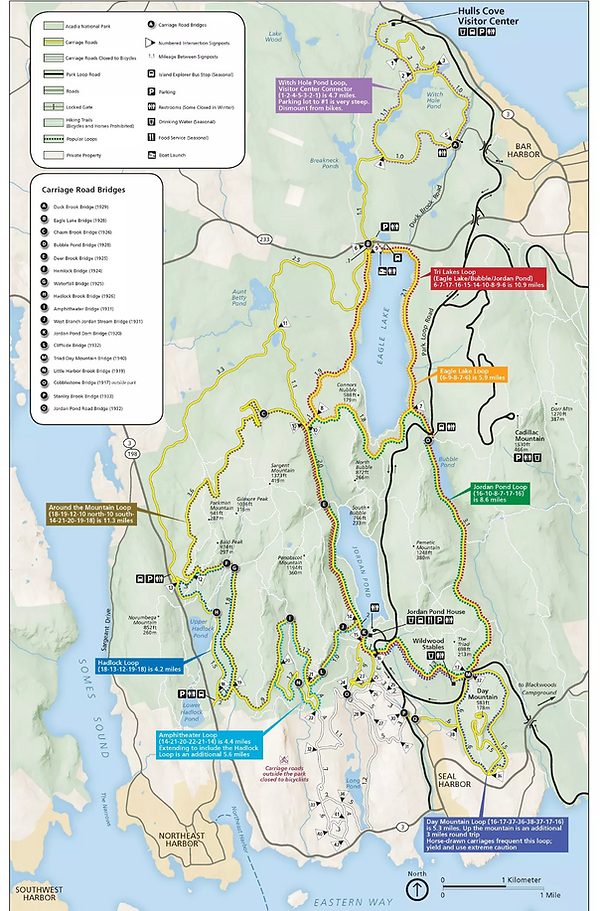
The carriage roads in Acadia were built between 1913 and 1940 by John D. Rockefeller Jr., who loved horses and carriage driving and wanted a quiet way to explore Mount Desert Island without automobiles. As cars started appearing on the island’s rough roads in the early 1900s, he worried they would spoil the peace for people on horseback and on foot, so he designed a completely car-free network just for them.
Rockefeller personally helped plan about 45 miles of crushed-stone carriage roads, designed with gentle grades and sweeping curves so horses and carriages could travel comfortably. The roads were carefully laid to follow the natural contours of the land and highlight views of mountains, ponds, forests, and the ocean. Along them, workers built 16 beautiful granite bridges and sturdy gatehouses, using local stone so everything blended with the landscape. The low granite boundary stones along the edges—sometimes called “Rockefeller’s teeth”—help protect both visitors and the terrain.
Over time, Rockefeller and his family donated the roads and much of the surrounding land to what became Acadia National Park. Today, the carriage roads are on the National Register of Historic Places and are still car-free, used for walking, biking, horseback riding, and cross-country skiing, carrying on his original vision of a quiet, horse-friendly way to experience the park.
History of Bar Harbor

Indigenous Roots
Long before Bar Harbor had a name, the area was home to the Wabanaki people, who lived seasonally along the coast and islands, harvesting fish and shellfish and traveling the waters of Frenchman Bay. Their deep knowledge of the land and sea shaped the region for thousands of years.
Early Settlement & the Name “Eden”
European settlers arrived in the late 1700s, drawn by fishing, shipbuilding, and farming. The town was originally called Eden, after Sir Richard Eden, an English statesman. Life here was rugged and maritime, centered on the working harbor and the surrounding forests.
Artists Discover the “Rusticators” (Mid-1800s)
In the 1840s and 1850s, landscape painters from the Hudson River School began visiting Mount Desert Island, captivated by its dramatic cliffs, clear light, and mountain-meets-sea scenery. Their paintings brought national attention, attracting early summer visitors—known as “rusticators”—who sought nature, simplicity, and fresh air.
The Gilded Age & the Golden Era of Bar Harbor
By the late 1800s, Bar Harbor had become one of America’s most fashionable summer resorts. Wealthy families such as the Rockefellers, Morgans, Astors, and Vanderbilts built grand summer “cottages” —especially along the shore of Frenchman Bay’s famed Millionaires’ Row. Yacht races, garden parties, and carriage rides defined the season.
Around 1913, John D. Rockefeller Jr. began building his famous carriage roads, starting with “horse roads” on his own property. He continued construction until about 1940, creating 57 miles of auto-free, broken-stone roads and bridges for public enjoyment, which he later donated to the park.
The Great Depression and changing economics slowed this era, but the biggest single turning point came in 1947.
From Private Land to Public Treasure: Acadia National Park
Thanks largely to private donations—especially from Rockefeller, who donated over 10,000 acres, and conservation-minded residents—the land surrounding Bar Harbor became Acadia National Park, the first national park east of the Mississippi. The park preserved the island’s wild beauty while making it accessible to all.
The Great Fire of 1947
In October 1947 a devastating fire swept through Bar Harbor, destroying much of the town and many of the grand cottages. The fire was pronounced completely out on November 14th, almost a month later, marking the end of the Gilded Age. The fire burned 17,188 acres on Mount Desert Island; more than 10,000 acres of that was within Acadia National Park. The business district was spared but destroyed 170 permanent homes, 67 seasonal “cottages” along Millionaire’s row, and five large historic hotels near downtown.
After The Great Fire
Bar Harbor rebuilt, but many of the grand cottages were never replaced; tourism returned in a new form—more inns, motels, and seasonal visitors tied closely to Acadia’s growth and modern outdoor recreation. The fire also reshaped the island’s forests, shifting large areas toward more deciduous regrowth in the decades that followed.
Bar Harbor Today
Today, Bar Harbor is a vibrant blend of working harbor, historic town, and gateway to Acadia. Lobster boats still head out at dawn, carriage roads welcome walkers and cyclists, and visitors come from around the world to experience the same beauty that first inspired artists over a century ago.
History of Mount Desert Island


Mount Desert Island was formed over millions of years through a process of volcanic activity, tectonic plate collisions, and glacial erosion. About 420 million years ago, molten granite from volcanic intrusions cooled to form the island's bedrock, and later, massive continental glaciers carved the landscape into the U-shaped valleys and rugged features seen today.
Mount Desert Island's history spans over 5,000 years, from its first inhabitants, the Wabanaki people, to European explorers, early settlers, and the development of its current status as a tourist destination and home to Acadia National Park. Early European visitors like Samuel de Champlain named the island "Isle des Monts Desert," meaning "island of the bare mountains". The 19th century brought significant growth with industries like shipbuilding and fishing, followed by wealthy summer visitors who helped shape the island's modern identity.
Native American settlement
-
The Wabanaki people inhabited the island for at least 6,000 years, calling it Pemetic, or "the sloping land".
-
They used birch bark canoes and built conical, bark-covered dwellings, living on the coast in winter and moving inland in the summer for resources.
European exploration and early settlement
-
In 1604, French explorer Samuel de Champlain named the island "Isle des Monts Desert" after its treeless mountain summits.
-
The French established the first mission in America on the island in 1613.
-
The first permanent European settlement, Somesville, was established by Abraham Somes in 1761.
-
Other settlements followed, and by 1796, the settlement of Eden (now Bar Harbor) was incorporated.
Industrial and commercial development
-
By the 1800s, settlers engaged in industries like fishing, lumbering, and farming.
-
Shipbuilding became a major industry, with a significant increase in vessel construction starting around 1820.
-
The first toll bridge connecting the island to the mainland was built in 1837.
The "Gilded Age" and tourism
-
In the late 1800s, artists from the Hudson River School helped make the island famous by depicting its scenery in their paintings.
-
This led to wealthy industrialists and families, such as the Rockefellers and Vanderbilts, building grand "cottages" and creating a summer resort destination.
-
The desire to protect the island's beauty led to the creation of Acadia National Park, the first national park in the eastern United States.
Modern era
-
Many of the grand estates were destroyed in a large fire in 1947.
-
Today, the island remains a popular tourist destination, with its population swelling significantly during the summer months.

Acadia National Park
History, Historic Bridges, Gatehouses and Engineered Trails
A Short History of Acadia National Park
Acadia National Park was established in 1916, making it the first national park east of the Mississippi River. Its creation was driven by conservation-minded citizens and philanthropists who recognized the need to protect the rugged mountains, forests, lakes, and dramatic coastline of Mount Desert Island.
Originally named Sieur de Monts National Monument, the park later became Lafayette National Park before finally being renamed Acadia National Park in 1929. Over time, generous land donations expanded the park and helped preserve the landscape that millions of visitors enjoy today.
In addition to its natural beauty, Acadia is famous for its remarkable early 20th-century engineering and craftsmanship. Visitors can explore 17, (of 32), historic stone bridges, two elegant gatehouses, and a vast network of carefully constructed trails—many of which are now recognized on the National Register of Historic Places. Iconic routes like the Beehive Trail and the Precipice Trail showcase the bold, innovative trail design that allows hikers to experience Acadia’s most dramatic cliffs and views.
Engineering and Craftsmanship in the Landscape
Acadia National Park is not only famous for its scenery, but also for its thoughtful and enduring design. From hand-crafted stone bridges and gatehouses to carefully engineered mountain trails, much of what visitors use today was built to blend beauty, durability, and access into a rugged coastal environment.
Historic Stone Bridges (Carriage Roads)
The carriage road system includes 17 major stone-faced bridges, built primarily between 1917 and 1933 under the direction of John D. Rockefeller Jr. Each bridge was uniquely designed to fit its setting, using native granite and graceful arches or spans. Many visitors seek these out as destinations in themselves.
Historic Gatehouses
There are two historic carriage road gatehouses, both designed in a Tudor Revival style and meant to serve as elegant entrances to the road system:
Intricately Engineered Historic Trails
Acadia’s trail system is a masterpiece of early trail engineering. Many routes were built with hand-cut stone steps, retaining walls, iron rungs, ladders, and carefully placed pathways to navigate steep and exposed terrain. In 2022, the Mount Desert Island trail system was listed on the National Register of Historic Places in recognition of its historic and engineering significance.
Famous iron-rung and ladder trails:
-
Precipice Trail – A dramatic cliff-face route using iron rungs, ladders, and narrow ledges.
-
Beehive Trail – A shorter but exposed climb using ladders and iron rungs with spectacular views.
Other historically engineered trails (with major stonework and construction features)
-
Perpendicular Trail – Notable for its long stone staircases built by CCC crews.
-
Gorham Mountain / Cadillac Cliffs area trails – Stone steps and ledge-crossing construction.
-
Kane Path
-
Beachcroft Path
-
Champlain South Ridge Trail – Extensive stone stairwork and historic trail construction.
-
Together, these bridges, gatehouses, and trails represent one of the finest examples of early park design in the United States—where engineering, craftsmanship, and natural beauty were intentionally blended. Exploring them today is not just a scenic experience, but also a walk through living history.
Click on the links below to explore more about Acadia’s historic structures, carriage roads, bridges, and iconic trails.


Military History
Mount Desert Island, Acadia & Frenchman Bay
From colonial conflict to World War I, World War II and the Cold War
Long before Acadia became a national park, Mount Desert Island and the waters surrounding it occupied an important position along the northeastern coast. French and English colonial rivalry, the American Revolution, two world wars and the Cold War all left their mark on the region.
1613 - Fighting at Saint-Sauveur
French Jesuits established the Saint-Sauveur mission on Mount Desert Island in 1613. Its exact location remains uncertain, although Fernald Point near Somes Sound has traditionally been associated with it. An English force from Virginia commanded by Samuel Argall attacked the French settlement that summer. Several Frenchmen were killed, others wounded, and the mission was destroyed. The episode was part of the larger struggle between France and England over control of northeastern North America.
Learn more: Acadia National Park - Military History
1775-1783 - The American Revolution
Mount Desert Island was not the scene of a major Revolutionary War battle, but the surrounding region was contested territory. Residents faced British naval activity, privateers and the uncertainty of living between British-controlled Canada and revolutionary New England.
Across Frenchman Bay on the Schoodic Peninsula, Thomas Frazier, identified by the National Park Service as the first documented free African American resident of what is now Schoodic, enlisted in 1780 in a company of rangers stationed at Frenchman Bay.
Learn more: Acadia National Park - Military History
1779 - The Penobscot Expedition
British forces occupied Castine and began constructing Fort George, intending the region to become part of a loyalist colony called New Ireland. Massachusetts responded with a large expedition of soldiers and ships to drive them out. Paul Revere served as commander of the expedition's artillery. After a disastrous siege and the arrival of British reinforcements, American vessels were burned, scuttled or captured as the expedition retreated up the Penobscot River.
Learn more: Maine Atlas - The Penobscot Expedition
Historic site: Maine Historic Preservation Commission - Fort George
1814 - The British Return
During the War of 1812, British forces returned to eastern Maine. In September 1814 they captured Castine, established a regional military headquarters and moved up the Penobscot River. The British again contemplated a province called New Ireland. The occupation ended following the Treaty of Ghent.
1844 - Fort Knox
Repeated British incursions convinced the United States that the Penobscot River needed stronger defenses. Construction of Fort Knox began in 1844 at Prospect, overlooking the river. The massive granite fort was intended to prevent an enemy fleet from reaching Bangor. Troops were stationed there during the Civil War, but Fort Knox never fired a shot in battle.
Visit/Learn more: Fort Knox State Historic Site
1917 - Otter Cliffs Naval Radio Station
On August 28, 1917, the U.S. Navy commissioned a radio receiving station at Otter Cliffs. The site had been developed with assistance from amateur radio pioneer Alessandro Fabbri, who offered his property and equipment to the Navy. Its remote coastal location had relatively little electrical interference, making it exceptionally effective at receiving weak transatlantic signals. Otter Cliffs became the Navy's principal transatlantic receiving station during World War I.
One of its most important moments came in November 1918, when the station received the first bulletin announcing the armistice ending the fighting in World War I. A memorial to Fabbri remains near today's Fabbri Picnic Area.
Learn more: NPS - Acadia Military History
1935 - The Navy Moves to Schoodic
As plans for the Park Loop Road expanded into the Otter Cliffs area, John D. Rockefeller Jr. helped fund relocation of the Navy station across Frenchman Bay to the Schoodic Peninsula. The U.S. Naval Radio Station at Winter Harbor was formally commissioned on February 28, 1935. The site would serve through World War II and much of the Cold War.
Learn more: NPS - Schoodic Navy Base & Otter Cliffs Transfer
Visit: NPS - Schoodic Peninsula
World War II
Cadillac Mountain Radar Station
Cadillac Mountain's elevation and unobstructed position made it valuable for national defense. In 1941 the summit was selected as a radar-station site, and the Army Air Corps operated the installation during World War II. The summit was closed to the public for security reasons and reopened in October 1945.
Learn more: NPS - Secrets of the Summit: Cadillac Mountain
October 1944 - Torpedo Testing in Frenchman Bay
In October 1944, the U.S. Navy tested 12 torpedoes against Bald Porcupine Island in Frenchman Bay. National Park Service history records that the 11th torpedo failed to explode; after waiting 45 seconds, the Navy fired the 12th. Decades later, the Army Corps of Engineers surveyed the island and found only remnants.
Learn more: NPS - Acadia Military History
July 2, 1944 - The Mystery of Navy Blimp K-14
U.S. Navy blimp K-14 crashed while conducting anti-submarine operations off the Maine coast. Six crew members died. Contemporary intelligence records documented suspicious reports in the surrounding waters, including explosions, a possible submarine sighting, an oil slick and debris. Later researchers have argued that a German submarine may have shot down K-14, but the Navy did not officially establish enemy action. The loss remains a debated World War II mystery.
Research starting point: U.S. Naval History and Heritage Command
November 29, 1944 - A German U-boat Enters Frenchman Bay
German submarine U-1230 crossed the Atlantic carrying two German agents as part of Operation Elster. On November 29, 1944, it entered Frenchman Bay under cover of darkness, navigating with bearings from Great Duck Island and Baker Island. The submarine eventually reached the vicinity of Hancock Point, where two German sailors used a rubber boat to land agents Erich Gimpel and William Colepaugh at Sunset Ledge Cove on Crabtree Neck.
The agents traveled to New York City but were eventually captured by the FBI. The landing site is listed on the National Register of Historic Places as the Nazi Spy Landing Site. For visitors standing on Mount Desert Island looking across Frenchman Bay today, it is remarkable to realize that a German U-boat secretly traveled through these waters during World War II.
Primary-source research: U.S. Naval History and Heritage Command
Historic property records: National Register of Historic Places - NPGallery
Related history: NPS - Acadia Military History
Bar Harbor Anti-Submarine Patrols
Today's Hancock County-Bar Harbor Airport in Trenton served as Civil Air Patrol Coastal Patrol Base No. 20. Civilian pilots and observers flew patrols over Maine's coastal waters searching for German submarines and watching over merchant shipping.
Historic photographs: Library of Congress
Seawall Naval Radio Station
In 1941, the Civilian Conservation Corps constructed a naval radio facility at Seawall. The installation was later dismantled.
Learn more: NPS - Acadia Military History
The Cold War at Schoodic
After World War II, the Winter Harbor installation continued to grow in importance. In 1950 it became part of the Navy's Naval Security Group, and its mission increasingly involved communications and signals intelligence during the Cold War. The installation eventually became known as Naval Security Group Activity Winter Harbor.
The Navy remained at Schoodic until 2002. Much of the former base was transferred to the National Park Service, and today the campus is home to Schoodic Institute, Acadia's research and education center. Former military buildings survive, including Rockefeller Hall, allowing visitors to explore a place that served the Navy through World War II and much of the Cold War.
Visit: NPS - Schoodic Peninsula
Learn more: Schoodic Institute
Military History You Can Visit Today
Otter Cliffs / Fabbri Picnic Area - WWI naval radio history and the Alessandro Fabbri memorial.
Cadillac Mountain - Site of a WWII radar and early-warning installation.
Schoodic Peninsula - Former U.S. Navy radio & security installation; Rockefeller Hall and the former Navy campus remain.
Fort George, Castine - Surviving earthworks associated with the 1779 British occupation and Penobscot Expedition.
Fort Knox, Prospect - A remarkably intact 19th-century granite coastal-defense fort.
History of the Lobster
From “Sea Roaches” to Seafood Royalty
The Remarkable Story of the American Lobster
Long Before the Colonists
Long before European settlers arrived, the Indigenous peoples of the Northeastern coast—including the Wabanaki Nations of present-day Maine—understood the value of the American lobster.
Lobsters provided an important source of food, were used as bait for fishing, and were even buried in fields as fertilizer to enrich the soil for growing crops.
Many historians believe the traditional New England clambake has its roots in Indigenous cooking methods. Lobsters, clams, and other seafood were wrapped in seaweed and cooked over hot shoreline rocks centuries before European settlers arrived.
To the region’s first inhabitants, lobster wasn’t a luxury or a nuisance—it was simply another gift from the sea.
17th–18th Centuries
It's almost impossible to imagine today, but there was a time when lobster was one of the least desirable foods in New England. So plentiful that it was often taken for granted, lobster became a symbol of poverty rather than a prized delicacy.
A Poor Man’s Food
-
Lobsters were so abundant along the New England, specifically along the coastlines of Massachusetts and Maine, that they washed ashore in piles up to 2 feet high.
-
They were considered a nuisance and nicknamed "sea roaches."
-
Commonly used as fertilizer, fish bait, and cheap food for prisoners, indented servants, and apprentices.
-
The reputation was so poor that some servants protested being fed lobster so often.
-
Colonies eventually passed laws limiting lobster meals for prisoners and servants to no more than three times per week.
The Invention That Changed Everything
Lobster's journey from "poor man's food" to gourmet delicacy began in the mid-19th century. Commercial canning made it possible to ship lobster across the country, while expanding railroad networks introduced it to inland travelers who had no knowledge of its humble reputation. As popularity increased and lobster became scarcer, it quickly evolved into one of America's most celebrated luxury foods.
The Canning Boom (1840s)
Before canning, fresh lobster spoiled incredibly fast and could not be shipped long distances.
-
Canning allowed lobster to be shipped nationwide before refrigeration existed.
-
In 1842, the nation’s first lobster cannery was established by The U.S. Treat Cannery in Eastport, Maine.
-
Mass Affordability: The process required roughly 3.5 pounds of live lobster to produce a single 1-pound can, which initially sold for just five cents.
-
A Nationwide Commodity: By the 1880s, Maine was home to 23 specialized canneries. Firms like the Burnham & Morrill Company, (famous for B&M Baked Beans), began shipping preserved lobster across the country, from Ohio to California.
-
The Cultural Shift: For Midwesterners and inland consumers who had never seen thousands of lobsters rotting on a beach, the canned meat was viewed as a novel, highly appealing, and affordable protein.
The Railroad Effect (1850s–1880s)
As train tracks pushed further into the American interior, railroad companies realized they could exploit this cheap, abundant coastal resource to feed passengers.
-
The Illusion of Luxury: Train operators began serving fresh, cooked lobster in their dining cars. Because it was cheap to procure, they could serve it to passengers at a reasonable price.
-
Ignorance is Bliss: Inland travelers, entirely unaware that lobster was considered a "trash insect" back in New England, were charmed by the strange, exotic-looking seafood. They found it delicious and associated it with the elegance and novelty of modern rail travel.
-
Fresh Shipment: The development of refrigerated rail cars and specialized "lobster smacks" (boats with live-wells) eventually allowed the industry to transport live lobsters packed in ice directly to major inland cities.
From Everyday Food to Fine Dining
When these rail passengers returned home from their travels, they began demanding lobster at their local brick-and-mortar establishments. High-end restaurants in New York City and Boston took notice. Chefs stopped boiling the meat into an unappetizing mush and instead began serving it fresh, paired elegantly with clarified butter and sophisticated presentations.
By the turn of the 20th century, surging demand collided with a dwindling supply from over-harvesting. As the population of lobsters naturally decreased, scarcity took effect—officially cementing its status as an expensive luxury item.
Wartime Influence
Both the hardships of wartime rationing and the brutal conditions of early industrial canning played pivotal roles in shaping the modern lobster industry.
The Wartime Booms: How Scarcity Created a Luxury
Historically, major American conflicts inadvertently acted as massive marketing and distribution campaigns for lobster.
1. The Civil War (1861–1865)
Before the war, canned lobster was a modest regional product. When the conflict erupted, the Union Army needed massive quantities of non-perishable, high-protein rations for soldiers in the field.
-
The Union Contract: The U.S. government bought up virtually the entire output of Maine’s lobster canneries.
-
The Military Diet: Hundreds of thousands of soldiers from all over the country were introduced to the taste of lobster through their daily field rations.
-
Post-War Demand: When surviving soldiers returned home to the Midwest and South, they brought a newly acquired taste for lobster with them, creating a massive, permanent domestic market that persisted long after the war ended.
2. World War II Rationing (1939–1945)
By the 1940s, lobster was already leaning toward a luxury status, but World War II solidified its place at the apex of fine dining.
-
The Rationing Loophole: To support the war effort, the U.S. government strictly rationed staple proteins like beef, pork, chicken, and even popular fish. However, shellfish was exempted from the rationing point system because it was considered too perishable and volatile to manage.
-
The Only Meat on the Menu: Wealthy diners and restaurant-goers who had used up their ration stamps for the week could still go to high-end restaurants and order lobster without any restrictions.
-
The Romance Factor: Because it became the premier food for special occasions and date nights during a stressful wartime era, lobster became permanently intertwined with the concepts of celebration, romance, and opulence.
Life Inside a Maine Cannery
While consumers inland enjoyed the novelty of canned lobster, the reality inside the coastal Maine factories of the mid-to-late 19th century was incredibly harsh, exploitative, and dangerous.
-
Child and Family Labor: Canneries relied heavily on cheap, unregulated labor. Entire families, including children as young as seven or eight years old, worked side-by-side. Children were primarily used for small-handed tasks like picking tiny fragments of meat out of the legs and claws.
-
The Danger of Scalding and Boiling: The process required thousands of pounds of lobster to be boiled constantly in massive, open vats of water. The air inside the factories was thick with suffocating steam, and workers frequently suffered severe burns from splashing boiling water or accidentally touching the uninsulated vats.
-
Brutal Shell Cuts: "Pickers" spent 12 to 15 hours a day cracking open sharp, jagged shells with bare hands or rudimentary knives. Minor cuts and deep gashes were constant. Because antibiotics did not exist and workers were handled rotting organic matter, these cuts frequently led to severe, sometimes fatal, blood infections.
-
The Toxic Fumes: Sealing the cans required workers (often young boys called "cappers") to use hot soldering irons to melt lead-based solder onto the tin lids. Workers breathed in toxic lead and chemical flux fumes all day in tightly packed, poorly ventilated rooms, leading to chronic respiratory illnesses and neurological damage.
-
Zero Job Security: The work was strictly seasonal and entirely dependent on the daily catch. If the boats brought in a massive haul, workers were forced to stand on their feet for 18 straight hours until the meat was processed before it spoiled. If no boats came in, they received zero pay.
Saving the Lobster
The 1890s marked a critical turning point for the modern lobster industry. Conservation laws dismantled the destructive canning factories, while the mass adoption of the lobster trap transformed independent harvesting.
The 1890s Legal Crackdown: Banning the Canneries
By the late 19th century, the explosive national demand for canned seafood had pushed the New England lobster population to the brink of commercial extinction. Canneries were highly inefficient, often requiring up to 5 pounds of live lobster to pack a single 1-pound tin.
Because large lobsters were heavily depleted, factories survived by processing increasingly tiny, juvenile lobsters. Local lobstermen—fearful of losing their livelihoods completely—campaigned heavily alongside conservationists for government intervention.
-
The 1895 Size Limit Law: The death blow to the factories came when the Maine Legislature passed a sweeping law in 1895 that established a strict, year-round minimum size limit on all caught lobsters.
-
Criminalizing "Shorts": It became strictly illegal to possess or process juvenile lobsters. Overnight, the tiny "shorts" that the canneries relied upon to fill their tins were outlawed.
-
The Cannery Exodus: Unable to legally or profitably procure enough meat to run their assembly lines, every single lobster cannery in Maine shut down or fled across the border into Canada by the end of 1895.
This legal pivot effectively saved the species from collapse and forced the entire market to shift toward the high-end, fresh, live-lobster trade we see today.
How the Lobster Trap Revolutionized the Industry
Before the mid-19th century, harvesting lobsters was a grueling, literal hands-on task. Fishermen either gathered them by hand from tidal pools at low tide or used hoop nets lowered from small boats. Hoop nets required a fisherman to sit over the water and pull the net up manually the exact second a lobster crawled onto it to eat the bait; if they were too slow, the lobster swam away.
The invention of the lathe pot (the wooden lobster trap) around the 1840s and 1850s changed everything. It was designed on a simple "funnel-and-parlor" concept: a mesh funnel allowed the lobster to easily climb inside to reach the bait, but made it nearly impossible to find its way back out.
This simple mechanical trap revolutionized the trade in several profound ways:
-
Passive Fishing: Lobstermen no longer had to sit and wait over a net. They could drop dozens of traps, row back to shore, sleep, and return the next morning to collect a guaranteed catch.
-
Deep Water Expansion: Traps allowed fishermen to move away from the heavily depleted coastlines and target deeper, offshore waters where massive, undisturbed lobster populations lived.
-
Mass Production: A single fisherman could manage a vast network of gear simultaneously. This scaled up supply to match the heavy demands of the shipping and restaurant industries.
-
Survival and Selectivity: Unlike nets or hooks, traps kept the lobsters alive, uninjured, and underwater until the fisherman pulled them up. This meant any under-sized juveniles or egg-bearing females could be easily sorted and tossed back into the ocean completely unharmed, laying the groundwork for sustainable fishing.
Lobster Pounds
Lobster pounds decoupled the seafood market from the unpredictable limits of weather and seasons, transforming a highly volatile summer trade into a highly lucrative, year-round luxury industry.
The Problem: The Summer Glut and Winter Scarcity
-
Before the late 19th century, lobstermen faced a severe economic trap. In the warm summer months, lobsters molted, became highly active, and flooded into shallow waters. Traps filled up instantly, causing the market supply to skyrocket and live prices to crash to near zero.
-
Conversely, during the freezing winter months, lobsters retreated to deep offshore waters and became sluggish. Heavy winter Atlantic storms made checking traps incredibly dangerous, causing live supply to vanish and prices to skyrocket exactly when no one could catch them. Because fresh lobsters rot rapidly once dead, dealers had no way to save summer surpluses for winter demand.
The Innovation: The Tidal Pound (1875)
-
The breakthrough occurred in 1875 on the island of Vinalhaven, Maine, located in Penobscot Bay. Innovators took inspiration from "smack boats"—vessels built with perforated wooden hull compartments that allowed fresh seawater to circulate freely through live-wells while in transit.
-
Dealers scaled this concept up to a massive, land-based level:
-
Natural Enclosures: They cordoned off deep, natural tidal creeks, coves, or harbors using fences, gates, or stone dams.
-
Tidal Circulation: The gates allowed the ocean's natural tides to rise and fall through the enclosure, constantly flushing out waste and introducing fresh, highly oxygenated seawater to nourish the crustaceans.
-
Long-Term Survival: Because lobsters can survive for months without food if kept in cold, clean, moving seawater, dealers could suddenly hold thousands of live lobsters healthy and intact for long periods.
How Pounds Revolutionized the Market
By the 1880s, tidal pounds spread rapidly across the New England coastline, fundamentally altering the economics of seafood:
-
Price Manipulation: Dealers acted like commodity traders. They bought massive gluts of cheap lobsters from fishermen during the summer bottom-out, held them alive inside the pounds for months, and then sold them to elite restaurants in New York and Boston during the winter for peak profit.
-
Shell Hardening: Summer lobsters often have fragile, "soft" shells from molting, making them too weak to survive rough rail transport. Keeping them in a pound allowed their new shells to naturally harden, transforming delicate, un-shippable catch into durable, high-value live inventory.
-
Stabilizing the Supply Chain: For the first time, major luxury hotels and restaurants could confidently put fresh lobster on their menus in January, knowing that coastal dealers could fulfill the orders regardless of blizzards or winter ocean conditions.
Today, while natural tidal coves are still used, the concept has evolved into massive, land-based, climate-controlled bio-filter facilities that can hold millions of pounds of live lobster to feed global air-freight demands.
The Legacy Lives On
Today, the American lobster is one of Maine's most valuable natural resources and an enduring symbol of the state's coastal heritage.
Strict conservation practices—including minimum and maximum size limits, protection of egg-bearing females, escape vents in traps, and careful fishery management—help ensure healthy lobster populations for future generations.
If you're lucky, you may spot lobster boats working the waters of Frenchman Bay during your stay at Baycliff. Each colorful buoy marks a trap resting on the ocean floor below, and every haul continues a tradition that has shaped Maine's coast for generations.
For centuries, lobster was viewed as little more than a nuisance washing ashore after storms. Today, it is one of Maine's greatest treasures and one of the strongest symbols of the state's coastal heritage. Whether you enjoy a classic lobster roll, a traditional shore dinner, or simply watch the boats at work, you're experiencing a living tradition that continues to define the character, culture, and spirit of coastal Maine.

Learn More About Acadia and the Natural Environment
The Learn About the Park section is the National Park Service's educational hub for Acadia National Park. It provides in-depth information about the park's natural environment, wildlife, geology, ecosystems, cultural history, and conservation efforts. Whether you're interested in learning about the plants and animals, understanding how glaciers shaped the landscape, or exploring the park's rich human history, this section serves as an excellent starting point.
🌿 Nature
Explore Acadia's remarkable natural world, from its forests and mountains to its rugged coastline and marine environments. Learn about the diverse ecosystems, plants, animals, and natural processes that make Acadia one of the most biologically diverse national parks in the Northeast.
Discover the wildlife that inhabits Acadia, including birds, mammals, fish, amphibians, reptiles, invertebrates, and marine life. Learn about their habitats, behaviors, conservation challenges, and how to observe wildlife responsibly.
Learn about more than 1,100 plant species found throughout Acadia, including mosses, lichens, fungi, wildflowers, evergreen forests, freshwater vegetation, and saltwater plants. Discover how the park's unique location supports an incredible diversity of plant life.
Explore more than 10,000 years of human history, from the Wabanaki Nations and early settlers to the philanthropists and conservationists whose efforts created Acadia National Park. Learn about historic structures, carriage roads, lighthouses, bridges, and the region's cultural heritage.
🌎 Natural Features & Ecosystems
Discover how Acadia's forests, mountains, coastlines, lakes, wetlands, streams, geology, and wildlife work together to form a diverse collection of interconnected ecosystems shaped by millions of years of natural processes.
Learn about Acadia's nearly 64 miles of dramatic Atlantic coastline, including granite cliffs, rocky headlands, cobble beaches, tide pools, sea caves, and the powerful forces of tides, waves, storms, and erosion that continue to shape the shoreline.
Explore Acadia's forests, where northern boreal and southern deciduous ecosystems meet. Learn about native tree species, forest succession, wildlife habitats, and the ecological importance of these woodlands.
Discover Acadia's more than 20 mountains, including Cadillac Mountain, the highest point on the U.S. Atlantic coast. Learn how glaciers sculpted the park's granite peaks, cliffs, and valleys over thousands of years.
Learn about Acadia's pristine lakes and ponds, their glacial origins, the wildlife they support, and their importance as sources of drinking water and recreation.
Explore Acadia's wetlands, bogs, marshes, and swamps, which provide essential habitat for plants and wildlife while helping to filter water, reduce flooding, and support biodiversity.
Discover how streams, brooks, and watersheds connect Acadia's mountains, forests, wetlands, lakes, and coastline while providing vital habitat for fish, wildlife, and aquatic plants.
Learn why Acadia is recognized for its exceptionally dark skies, making it one of the premier destinations on the East Coast for stargazing, astronomy, and night photography. Explore efforts to reduce light pollution and preserve these remarkable nighttime views.
Discover the spectacular mountain summits, carriage roads, coastal overlooks, and iconic vistas that define Acadia, while learning how scientists and park managers work to preserve these scenic landscapes for future generations.
🪨 Geologic Features & Formations
Journey through hundreds of millions of years of geologic history and discover the remarkable features that tell Acadia's story—including granite cliffs, glacial erratics, striations, chatter marks, polished bedrock, sea cliffs, beaches, and other landforms created by volcanic activity, glaciers, and ongoing coastal erosion.